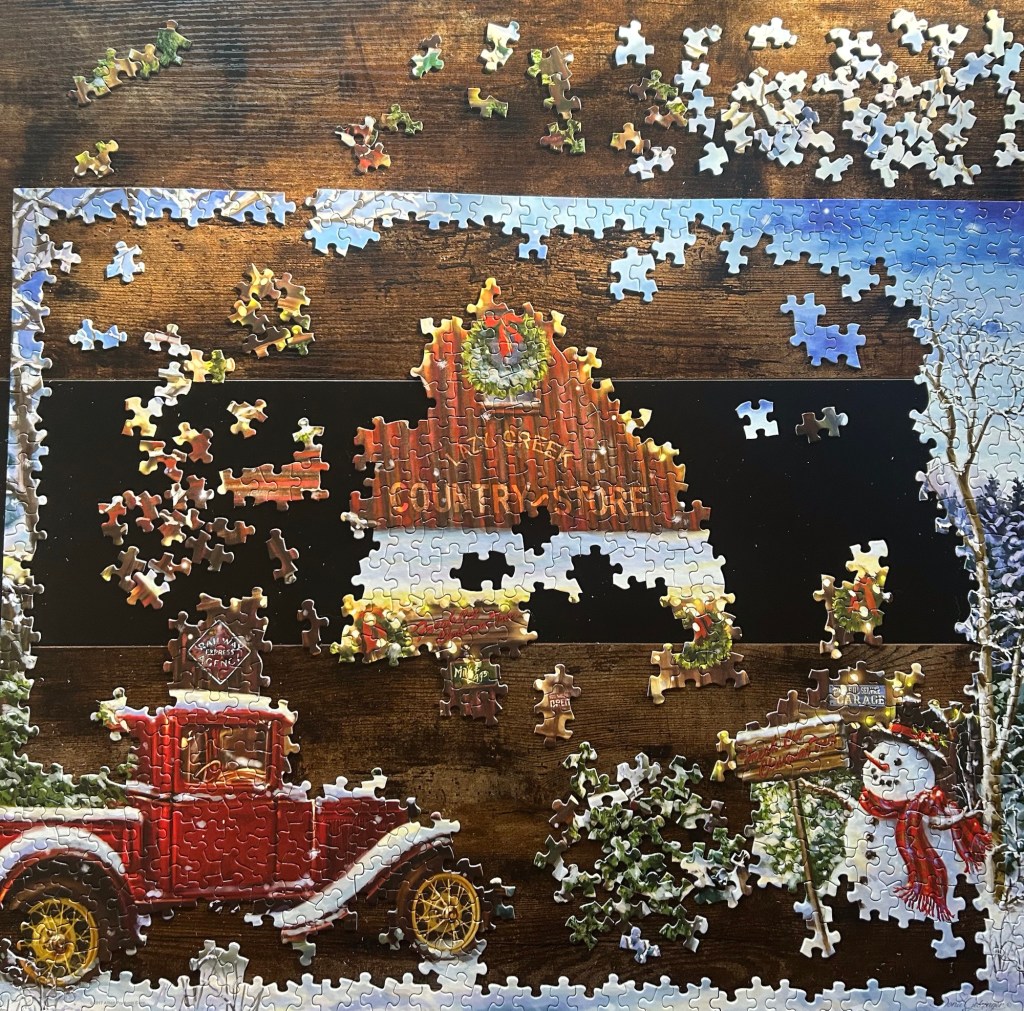
There are no extra pieces in the Universe. Everyone is here because he or she has a place to fill, and every piece must fit itself into the big jigsaw puzzle.
Deepak Chopra
How we navigate and interact with information rests heavily on the types of learners that we are. Do we primarily need to hear, see or touch information in order to comprehend and reuse it?
Shortly after settling in for a Christmas visit, my son cleared the dining room table and scattered the pieces of a 1,000 piece puzzle all about. He set to work immediately by starting the outer framework. Since I hadn’t worked on a puzzle in years, I took my tea mug and sat on the opposite bench.
The cover of the puzzle box was set before us. We studied the image carefully. I saw the big picture and, not surprisingly, began to create a story about the country Christmas scene. My first approach was sorting all of the puzzle pieces into categories by color. All the greens for the pine trees and the wreaths. All the reds for the General Store and the pick up truck. All the blended gray, blue tones for the sky and snow. I am a visual learner.
My son is also a visual learner, though his approach was different than mine. After building a significant part of the outer framework, he focused his concentration on a specific area of the puzzle. In search of a single piece, he lasered in on it amid the hundreds strewn and placed it in its proper location.
I am fascinated watching how people think, perceive and manage tasks within their learning styles. As a middle school learning specialist, I witness daily examples to confirm that every person learns information in a most personal and unique way. Recently, our school Learning Center hosted a seventh grade workshop to introduce the concept of understanding learning styles. To start with, each student completed a basic, non-scientific online survey to highlight their learning style.
In the following weeks, we gathered students into smaller groups and reviewed learning via three styles: auditory, visual, and tactile. The students were receptive and curious of the topic. We explained that as learners we have a blend of all three styles, but that one style will always be prominent.
With our Christmas puzzle underway, we were together but not always working together. Everyone was in their own flow and thinking about their next steps. Sometimes we worked together offering a puzzle piece when someone called out for a certain shape and color. There were no electronics anywhere in sight. There was great reward in the decision to sit and just be. The blend of individual and collaborative creation has long been my preference in learning and doing.
Our goal was to complete the puzzle by Christmas Day. Perhaps a lofty goal as our events, gatherings and travels pulled us here and there for the few days before Christmas. We brought our collective strategies, strengths and styles to the literal table, and to the process, believing this goal could actually be achieved.
Every time we passed by the puzzle we were compelled to stop, even if for only five minutes and search for a piece to drop in. On Christmas Eve, we returned home late from a family gathering. The puzzle beckoned. We set forth once again on the last 100 or so pieces. As midnight struck, my eyes stopped focusing. I bid farewell. I awoke early Christmas morning to a wonderful gift! The completed puzzle displayed on the dining room table. I learned that they finished it together at 1:05 a.m. on Christmas morning!
This puzzle was shared by its first owner who had already completed it once. The completed puzzle displayed five gaps that looked like missing teeth. I appreciated the reminder that not everything is always perfect and neatly tidied up. Loose ends here and there are always to be expected. Must always be expected. Our imperfect Christmas puzzle was a perfect reconnecting point for the four days and nights before Christmas. We were relaxed, industrious, and together.
When we welcome collaborative teaching and learning in our lives we grow in mind and spirit. When we welcome multigenerational learning spaces we grow based on blended, shared experience and expertise. There is no too old or too young in learning. The beauty is in the blend. In the collaboration. And in reaching the completed, even if slightly imperfect, goal.
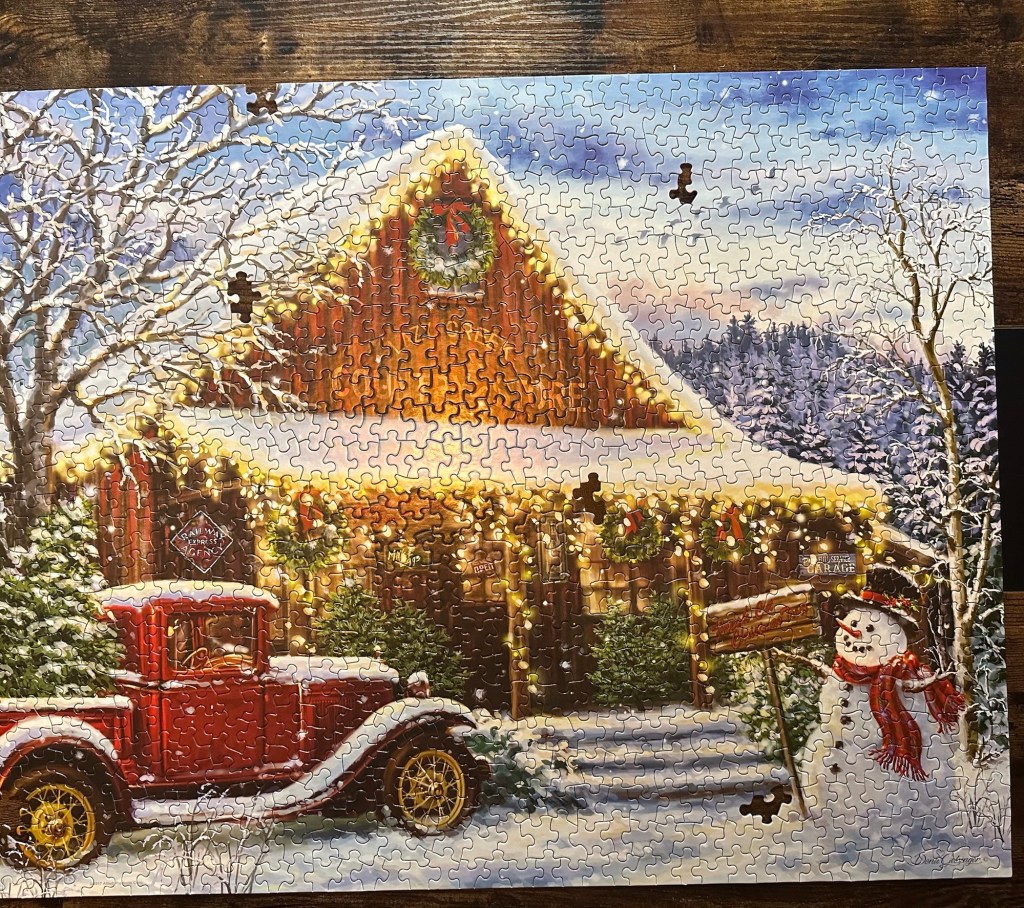
December 25, 2023 1:05 a.m.

